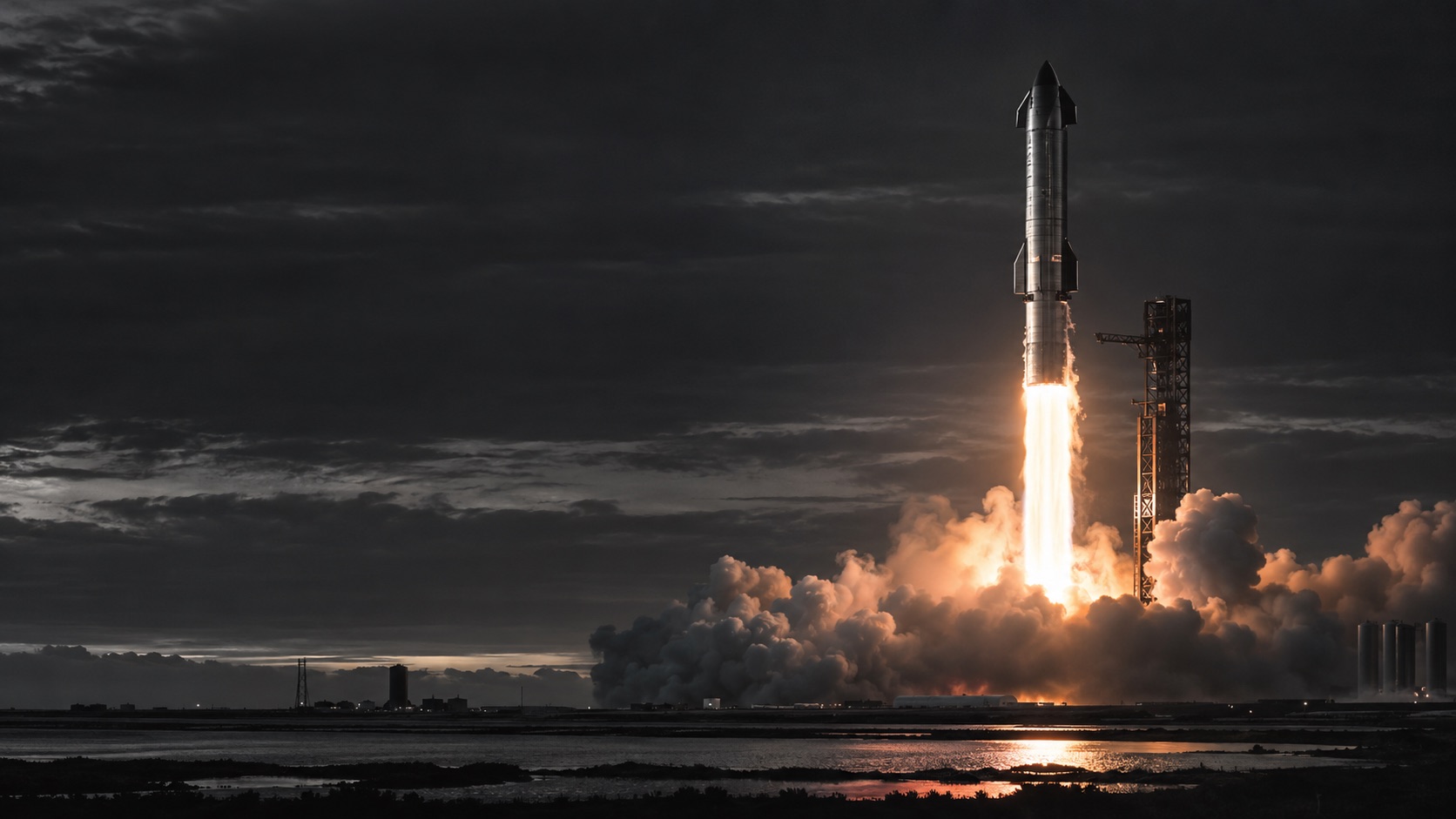
A launch can look successful from the ground long before the mission has answered its hardest questions. Flight 14 carried another kind of meaning for me. It flew on an anniversary shared by two different versions of the future—and reminded me that my interest in what comes next began long before I knew how anything was made.
On September 28, 2026, Starship lifted off on Flight 14 and reached orbit for the first time. SpaceX says the vehicle deployed 26 Starlink V3 satellites before flight controllers shortened its time in orbit and directed it toward a controlled splashdown in the northern Pacific. The mission did not follow every part of the original plan, but it crossed the boundary the previous thirteen tests had approached.
Three futures share one date.
September 28 already carried two anniversaries. Star Trek: The Next Generation premiered on September 28, 1987. Twenty-one years later, on September 28, 2008, Falcon 1 became the first privately developed and funded rocket to reach orbit. Flight 14 arrived exactly 39 years after one imagined future and 18 years after another machine proved a new route into space.
Those dates feel personal because science fiction entered my life through my dad. He was a big Star Trek fan when I was growing up, and his interest helped make the future feel like a place worth thinking about. Science fiction was not only escape. It was an early language for technology, exploration, responsibility, and the kind of people we might become when our tools changed.
Before that trip to the theater, my dad had bought the original Star Wars trilogy as a DVD set. Five-year-old me had watched those movies and was ready to see how Darth Vader came to be. In 2005, the year I turned six, my dad took me to the theater at Long Beach Towne Center in Long Beach, California, to see Revenge of the Sith. It blew my mind. The opening battle made the galaxy feel enormous, R2-D2 confirmed his place as the best copilot, and Vader’s beginning finally had an answer.
The movie did not disappear when we left the theater. I had the LEGO set with Obi-Wan and General Grievous, and I still have a Revenge of the Sith poster that came from a Best Buy promotion. I still think it is the best Star Wars movie. The poster has lasted through every change in how I understand the film. At first it represented spectacle—ships, worlds, machines, and sound. Later it became a story about ambition, fear, loyalty, and what happens when immense capability outruns judgment.
I did not draw a straight line from that theater to Layered Goods. Influence rarely works that neatly. It accumulates. A television series my dad loved, a movie seen the year I turned six, a poster kept for more than two decades, a privately built rocket reaching orbit, and a new vehicle flying on the same date all became part of how I learned to look at objects and systems. What we imagine changes what we attempt. What we keep changes what stays available to shape us.
Space is a place. Orbit is a condition.
Going to space means crossing an altitude. Staying in orbit means moving sideways so quickly that the vehicle continually falls around the planet. That distinction is why the word “orbital” matters. Previous Starship flight tests followed trajectories designed to end without remaining in orbit. Flight 14 stayed up, completed orbital flight, and then used a deliberate return sequence to come back down.
That deorbit burn may sound like a detail. It is the opposite. Launch puts energy into a vehicle; responsible orbital flight must also provide a dependable way to remove that energy. The ability to come down at the intended time and place turns a dramatic machine into an accountable one.
Payload changes the mission.
The satellites matter for the same reason. A test vehicle proves parts of itself. A launch vehicle performs work for something else. Deploying 26 Starlink V3 satellites moved this flight from a pure development exercise toward the operating rhythm a transportation system eventually needs: integrate a payload, protect it through ascent, place it where it belongs, and verify the sequence.
Payload also makes every design trade more honest. Mass, volume, vibration, heat, software, and timing all begin to answer to an external job. The rocket can no longer be impressive only on its own terms.
From orbit to the phone.
Starlink V3 also connects this launch story to the expansion of satellite service into mobile devices. Starlink says technology developed for its V3 broadband satellites will support its upcoming Starlink Mobile Gen 2 satellites, designed to deliver LTE-level speeds directly to unmodified cellular devices. The distinction matters: V3 is the broadband generation; the next-generation mobile satellites apply that technology to direct-to-phone service.
SpaceX’s spectrum acquisition agreements with EchoStar supply another part of that plan. In September 2025, EchoStar announced an agreement to sell its AWS-4 and H-block spectrum licenses to SpaceX for approximately $17 billion. A November amendment added its unpaired AWS-3 uplink licenses for approximately $2.6 billion in SpaceX stock. The companies described the spectrum as a foundation for a next-generation Starlink Direct to Cell constellation, with a commercial agreement intended to give Boost Mobile subscribers access to the service.
That is the larger system behind the payload: launch capacity to put hardware in orbit, satellite technology to carry the connection, and licensed radio spectrum to reach a phone. Together, those pieces support the ambition to extend mobile coverage beyond terrestrial towers. Service availability still depends on the network rollout, supported devices and operators, and regulatory approvals.
The long test is repetition.
Reusable spaceflight is often summarized as landing a booster or recovering a ship. The larger idea is industrial. Can the same family of hardware be inspected, refurbished, fueled, launched, and flown again without treating every mission like a handmade exception? Can teams learn from one vehicle and transfer that knowledge to the next? Can the launch site, flight software, heat shield, engines, tracking network, and recovery plan behave like one product?
Flight 14 cannot answer all of that. No single mission can. It moved the work into a new environment where small problems had time to become large ones. Thermal cycling, orbital navigation, power management, communications, payload deployment, and the discipline of a planned return became part of the same test.
This is how prototypes become infrastructure: not when risk disappears, but when uncertainty is divided into questions that can be tested, measured, and asked again.
A machine with a second act.
The public image of a rocket is vertical—a tower, a countdown, a sudden upward line. But an orbital vehicle has a second act. It coasts. It turns. It waits. It starts an engine again. It meets the atmosphere at extreme speed and tries to keep its shape through heat and pressure. The less cinematic hours may reveal more about the future of the system than the first minute.
Layered Goods is interested in that shift from object to system. The object gets attention. The system earns trust. Flight 14 reached orbit, deployed its payload, and returned under control even after the plan changed. The headline is not simply that Starship went farther. It is that more of the whole idea had to work at once.
The machines I watched in science fiction as a kid were finished enough to disappear into the story. Real machines are never that clean. They carry history, failure, revision, labor, judgment, and the people who first taught us to care. That may be the most useful connection between the poster still in my room and the rocket that flew on September 28: neither tells me exactly what to make. Both remind me why I keep looking toward what could exist next.